
Building Community Through Adventure
Fall Outdoor Education 2026
Mariana Urrea, Admissions and Communications Associate
The trail is our largest classroom. Long before students ever leave the building, they’re practicing patience, meeting each other where they are, and finding their voice, lessons that travel with them into our hallway and beyond.


I joined the Explorer West Admin team last month, and had the privilege of joining the seventh grade crew on their fall Outdoor Education trip. Seventh graders were excited to build on the teamwork and basic camping skills they gained last year, and ready to continue expanding their skills in preparation of more challenging backcountry trips coming up later this year and next.
Seventh grade students spent time within Deception Pass, where we traveled through all types of terrain: beaches, forest, concrete, heights, you name it; much like the unknowns they navigate within our school building, before leaving feeling confident to face whatever comes their way.
What surprised me on my first Outdoor Education experience with Explorer West is how much ownership the students take. They carry group gear, divide up cooking responsibilities, build their own tents, and are basically self-sufficient throughout the whole experience. I was extremely impressed with how prepared Explorer West was for it all, and how quickly that preparation gave way to flexibility when plans shifted. Because sometimes, like anything in life, things change. And that’s part of the lesson too: staying flexible and adaptable.


Seventh graders at Deception Pass State Park
As a new participant, I had some of the same nerves as the students. I worried that, as someone they didn’t know well yet, I might not connect with them right away. Lisa, my co-leader and our seventh- and eighth-grade Language Arts teacher, did a great job at integrating me and establishing my presence within the group. I find joy in meeting new people and hearing their stories, so I came in as an enthusiastic participant.
The group comprised both students who knew each other well and those who weren’t as close. What I really appreciated was our Student Support team’s commitment to making great pairings, so everyone had at least one friend they could count on within the group. This was a great opportunity for students to grow socially and emotionally. I went in trusting everyone’s expertise, and even though I wasn’t close with anyone just yet, I knew we all had each other’s backs. That speaks volumes about the caring Explorer West community we cultivate, both within our building and outdoors.


Each individual is needed on these adventures, and each serves a purpose. Although some students might want to hike faster than others, they learn to wait. Students learn to portion meals to make sure everyone in the group is well nourished. They turn on their listening ears to make sure everyone gets a chance to express themselves. They build confidence by knowing they did something that they perhaps did not know they were capable of doing. They take moments to recenter themselves and celebrate the wins. They conquer fears by crossing tall bridges, and they become great humans by helping others.
Each of these lessons follows students right back into our school, as students bring these real-life experiences into their classwork. In science, they discuss glaciers, cells and systems, and the scientific process; in Language Arts they begin writing short stories; and in Social Studies, they dive into geography. The flexibility they practiced when plans changed on the trail is the same flexibility we see them bring to group projects and unexpected schedule changes at school. Not only are these adventures for personal development, but also serve as stepping stones into what awaits them when they return to the building.


In preparation for the trip, students watched informational videos on using WhisperLite stoves and packing a bag, then got hands-on practice. We also had critical conversations, like going over Leave-No-Trace principles and mapping our comfort zones – such as, where do we feel comfortable, where can we grow, and where might we start to panic – so we were ready for new settings and new challenges.
Students also got familiar with our gear library, which houses almost anything they might need for their adventures: clothing, tents, sleeping bags, and more. We introduced them to this space because gear can be a common barrier to entry in the outdoors, and because hands-on familiarity builds their confidence and agency, with proper guidance.
Our Outdoor Education program builds lifelong memories. I know I’ll be remembering my first Outdoor Education trip for years to come. Middle schoolers are respectful and courageous. They ask for help because that’s a sign of strength. And they are Falcons, on the trails and outdoors.

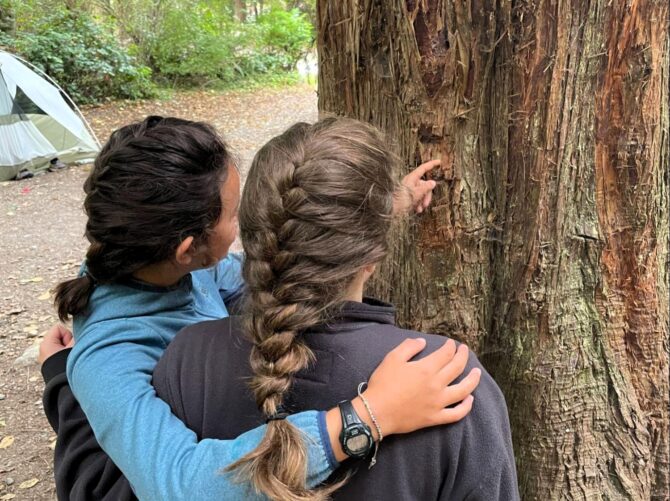

Seventh graders at Deception Pass State Park
In the winter, we’ll continue using the trails as our classroom by trying out snowshoeing and cross-country skiing. Sixth-grade students run a hands-on science experiment by building their own snowshoes, then testing and improving the design after each use while also building their problem-solving and collaboration skills.


